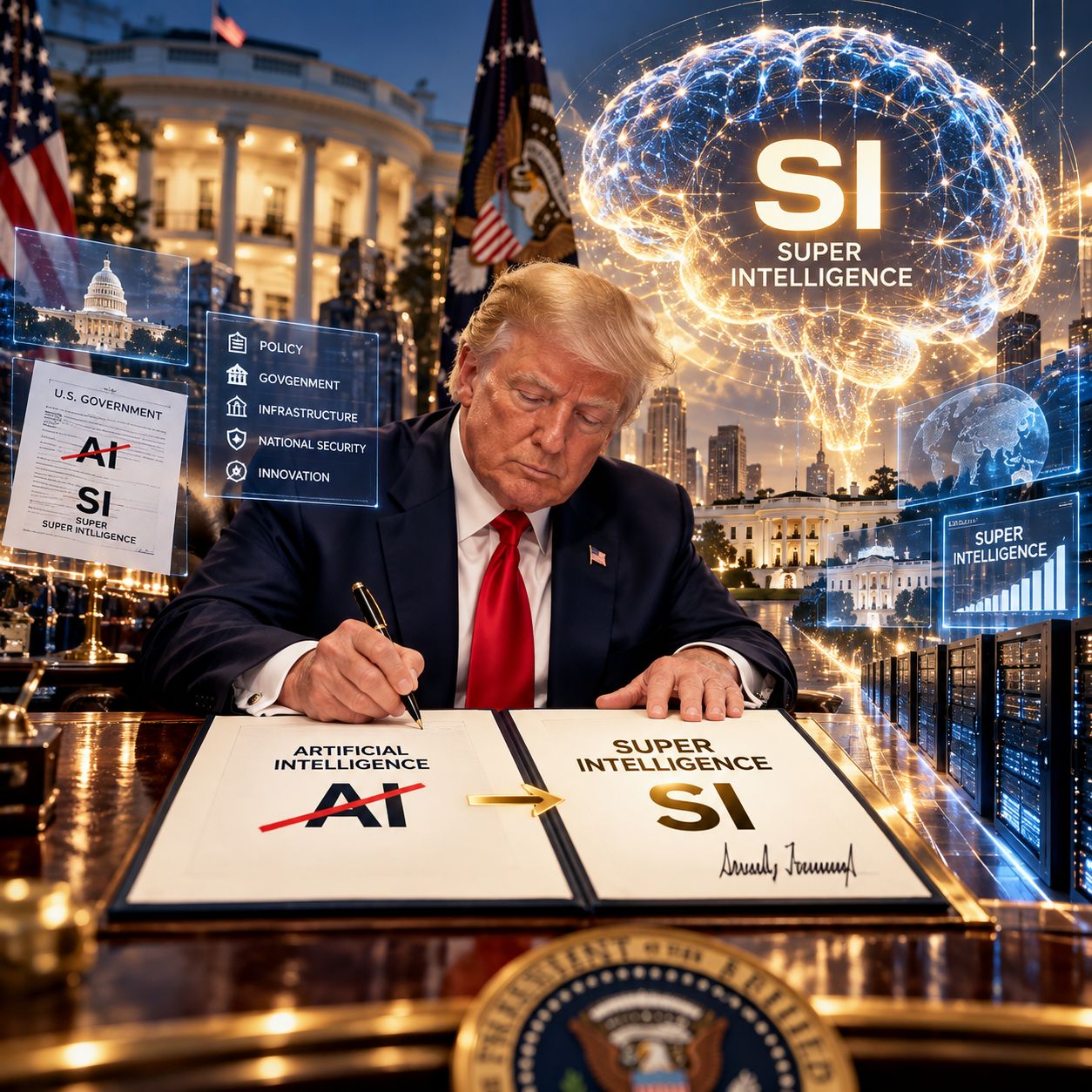
AI → SI. Artificial Intelligence is becoming "Super Intelligence" in U.S. government language.
President Donald Trump announced at the UN General Assembly that the United States would begin referring to Artificial Intelligence (AI) as Super Intelligence (SI) in government documents. And this is already moving beyond a speech — the U.S. State Department's international organizations bureau has reportedly instructed diplomats to replace references to "Artificial Intelligence" with "Super Intelligence" in its communications, according to the Washington Post.
The stated argument
Trump's argument is simple: the word "artificial" makes intelligence sound fake. He wants the United States to call it "super." But there is a much bigger conversation here than a branding preference.
A collision with existing terminology
In AI research, superintelligence already has a meaning — generally referring to intelligence that exceeds human capabilities. Renaming today's broad category of AI as "SI" therefore creates an interesting collision between political language and technical terminology, as Axios has noted. And terminology matters.
We went from Software → Machine Learning → AI → Generative AI → Agentic AI. Now the U.S. government is introducing AI → SI.
The technology itself hasn't suddenly changed because the terminology changed. But the ambition around it certainly has.
What this signals
The next global race may no longer be framed around who leads in AI. It may increasingly become a race around who builds intelligence beyond today's AI systems — and who controls it.
Welcome to the conversation around SI — Super Intelligence.